Sports Sponsorship ROI vs Traditional Advertising
TV ads are skipped. Banner ads are ignored. Sports sponsorship is the last format people actually pay attention to.
Every year, brands pour billions into TV spots, display advertising, and social media campaigns. And every year, those same brands watch their click-through rates fall, their reach fragment across platforms, and their budgets chase audiences who have become experts at ignoring them.
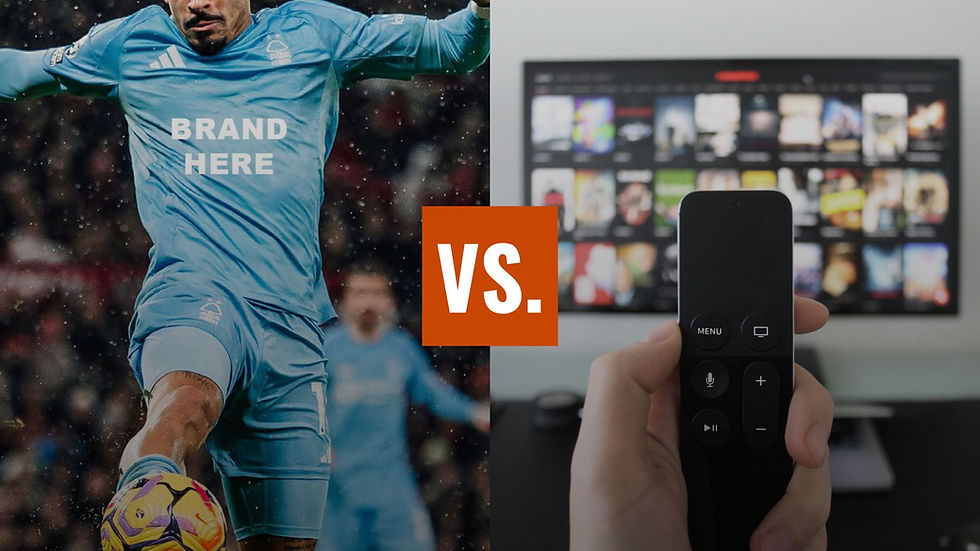
This is not a crisis that crept up on anyone. It has been visible for years. The average banner ad click-through rate has collapsed from 44% in 1994 to around 0.05% today. Skip buttons, ad blockers, and second screens have collectively made it easier than ever to pay a lot for very little.
Sports sponsorship occupies a different world entirely, and the data backs that up. This article sets out the commercial case for why brands that are still debating whether to invest in sports partnerships are asking the wrong question.
The Attention Economy Has a Sports Exception
The core problem with modern advertising is not reach. Most formats can still get you in front of a large audience. The problem is attention, specifically, the almost universal tendency of audiences to look away, scroll past, or simply not process what they are seeing.
Nielsen Norman Group research, tracking eye movement and attention across three decades of studies, consistently shows that web users have developed stable, automatic patterns of ignoring anything that looks like an advertisement, regardless of its relevance to them.
91% of people find online ads more intrusive now than they did two years ago. Sport is the exception, because nobody chooses to watch a match and then opts out of caring.
Sports is structurally different. When someone watches a football match, they are emotionally invested in the outcome. Their attention is not divided. They are not skipping ahead. And the brand visible on the shirt, on the perimeter board, or appearing in the moment of a goal celebration is part of the experience they chose, not an interruption to it.
Research says traditional advertising platforms can attain similar reach figures to sport, but cannot compete with sports fans' level of engagement.
The Numbers That Matter
Average banner ad click-through rate
Down from 44% in 1994.
Source: Nielsen Norman Group
Consumers who experience banner blindness
Consciously or subconsciously ignore banner ad
Source: Infolinks
People finding online ads more intrusive than 2 years ago
Source: ASTRAD consumer research
Sports fans more likely to feel positively about sponsoring brands
Source: Nielsen Sports global research
Higher ROI for focused vs spread sponsorship portfolios
Source: Nielsen, 2024
Sports sponsorship market projected value by 2034
From $91bn in 2024, CAGR of 7%
Source: Market Research Future
Key figures comparing traditional advertising effectiveness with sports sponsorship performance.
What Sports Sponsorship Actually Buys
When brands invest in sports sponsorship, they are not buying an ad slot. They are buying four distinct things that traditional advertising struggles to replicate.
Attention that was not forced. When a fan watches 90 minutes of football, sponsor branding appears hundreds of times in a context the fan chose and cares about. No skip button. No ad blocker. No second screen distracting them from the content they want.
Emotional association. Research shows that the trust and loyalty fans feel towards their teams transfers, to a measurable degree, to brands associated with those teams. This is the credibility transfer effect; the brand borrows some of the emotional equity that fans have built up over years of supporting a club or following an athlete.
Global reach with local depth. A Premier League shirt sponsor does not just reach the 40,000 people in the stadium. It reaches broadcast audiences, social media followers, highlights packages, press photography, and international streams simultaneously. A single deal activates multiple channels at once.
Long-term sales impact. This is perhaps the most underappreciated dimension. Nielsen Sports' Return on Sponsorship Investment (ROSI) framework found that the long-term impact of a sponsorship on sales represents 47% of the total sponsorship impact — meaning brands which measure only short-term metrics are understating their ROI by nearly half.
The Problem With How Brands Currently Budget
Despite the evidence, sports sponsorship represents only around 15% of the average brand's total marketing budget, according to Nielsen Sports. This creates a structural blind spot, particularly for brands that have become accustomed to the familiar metrics of digital advertising, even as those metrics have deteriorated.
Brands are measuring half the return and making budget decisions accordingly. The problem is the measurement model, not the channel.
The irony is sharp. Brands measure banner ad campaigns with granular precision and find click-through rates of 0.05%. They measure sports sponsorships imprecisely, miss the long-term impact entirely, and conclude the return is unclear. The problem is the measurement model, not the channel.
Further evidence of the commercial shift: in 2024, brands that consolidated their sponsorship portfolios, focusing spend on fewer, higher-impact properties rather than spreading thinly across many, saw a 12% increase in ROI compared to those with broader portfolio spread (Nielsen).
The lesson is not that sports sponsorship is expensive. It is that diluted sports sponsorship is expensive. Focused, well-negotiated, properly activated partnerships deliver measurable returns.
Football Specifically: Scale That No Other Channel Matches
It is worth isolating football as a channel, because the numbers operate at a different order of magnitude than almost any other marketing vehicle available to brands.
The 2026 FIFA World Cup was watched by over 5 billion people globally, one of the most-viewed events in recorded history. The UEFA Champions League Final draws approximately 450 million viewers. The Premier League distributes content to 188 countries. These are not niche audiences.
Meanwhile, on-kit branding consistently dominates fan attention. Research from FOR SOCCER found that jersey sponsorships achieved 56% active visibility among fans; more than half of all fans, across every viewing session, notice and register the sponsor on the shirt. This is active brand recall, delivered in an emotionally charged context, at scale.
For brands with global or cross-market ambitions, European football offers something that regional media buys cannot: an existing, passionate, culturally embedded audience that is already paying close attention.
The Activation Multiplier
One further distinction that comparisons with traditional advertising often miss: sports sponsorship is not a single channel. Done correctly, a single partnership generates content and coverage across multiple formats simultaneously. A brand that secures a Premier League shirt sponsorship gains, within that deal:
On-shirt visibility in every broadcast, stream, highlight, social clip, press photograph, and replica kit sold
Perimeter board and stadium branding across live and recorded broadcast
Digital and social rights to use the club's brand and imagery in the sponsor's own marketing
Access to player appearances, hospitality, and content creation opportunities
Association with the club's global fan community and accumulated brand equity
Each of these would cost significantly more to replicate independently through traditional advertising. Packaged as a single partnership and brokered correctly, they represent exceptional value per touchpoint.
The Bottom Line
Traditional advertising is not going to disappear. But the structural trends - skip rates, banner blindness, ad blockers, streaming fragmentation - are all moving in one direction, and they have been doing so for two decades.
Sports sponsorship is not immune to poor execution. A poorly chosen ambassador, an ill-fitting club partnership, or an activation plan that stops at logo placement will underdeliver like any other marketing investment. But a well-constructed sports partnership, matched carefully to brand objectives, executed with proper rights activation, and measured across both short-and-long-term impact, consistently outperforms the channels brands default to.
The brands winning the attention war are not the ones buying more banner ads. They are the ones showing up where audiences have already chosen to pay attention.
The question for brand marketers is no longer whether sports sponsorship delivers ROI. The evidence on that is clear. The question is whether your brand has the right relationships in place to access the right properties, at the right price, with the right activation plan behind it. That is exactly what Extra Time Sports Group was built to do.

Ready to make your marketing budget work harder?
Speak to ETSG about the right partnership for your business.